
Use the Transpose Objects option in the Configuration tab to change the format of data linked to the Tracking Manager Module. You can choose to transpose grades into numerical values or targets. This is useful when displaying data from different sources in your Tracking Models, as you can transpose the data into common values and compare data from different sources. Transposing data into common numerical values is useful for making calculations in your Tracking Models. The original data is still available to view in your Tracking Models.
Each Transpose Object consists of Transpose Elements. Use a different Transpose Element for each value you want to change in the Transpose Object. For example, setup a Transpose Object for effort grades. Setup Transpose Elements for each effort grade, changing a high effort grade of '1' to a value of '10' and a low effort grade of '5' to a value of '2'. Setup another Transpose Object for exam grades, transposing a high grade of 'A' to a value of '10' and so on. Apply the Transpose Objects to the data in your Tracking Model. You can then calculate an average of the numerical values listed and transpose your findings back to a grade to give a pupil's overall grade for the year.
An example of the Transpose Objects screen is shown below:
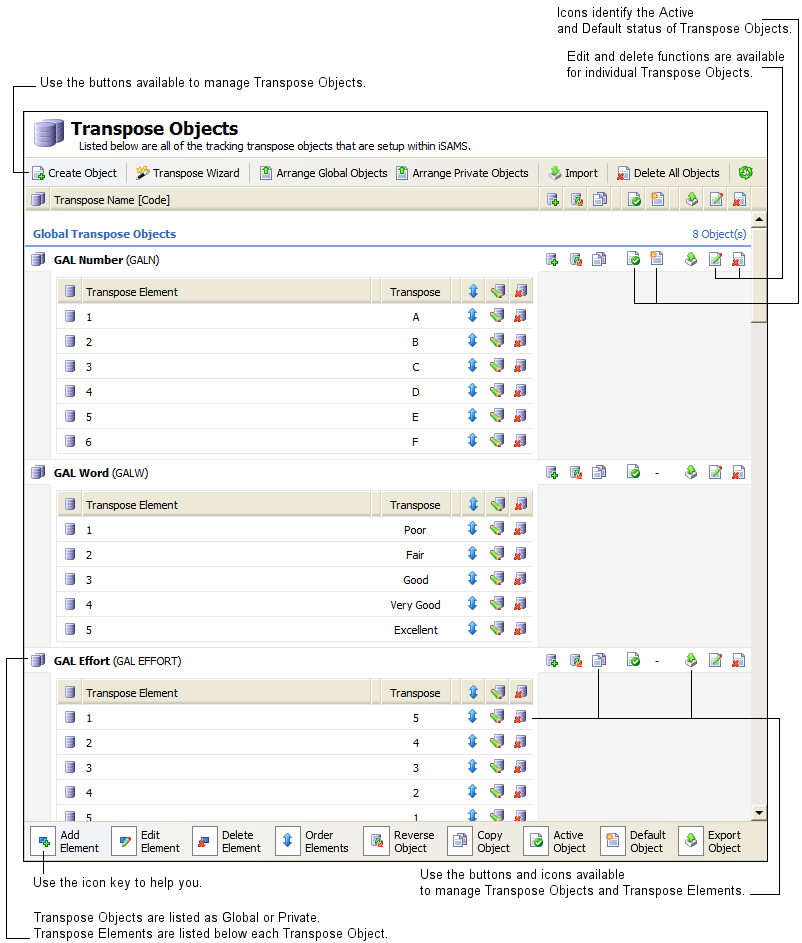
Use the functions available in the Transpose Objects screen to:
- Create a Transpose Object. Choose to setup the Transpose Objects to be used by all Tracking Manager Module users (Global Objects) or setup your own Private Objects. Private Objects can only be accessed by the user who has set them up. You can setup as many Transpose Objects as you require to alter the format of the different types of data used in the Tracking Manager Module.
- Add a Transpose Element to a Transpose Object. Use a different Transpose Element for each term that you want to transpose in the Tracking Manager Module.
- Use the Transpose Wizard. The Transpose Wizard takes you through steps to create a Transpose Object and add Transpose Elements to it. This ensures that you complete all the steps required to start using Transpose Objects in your Tracking Models.
- Copy an existing Transpose Object. This duplicates an existing Transpose Object which you can then edit to suit you. This saves time when you have different types of data that you want to transpose to same values.
- Reverse an existing Transpose Object. Choose to reverse the values used in a Transpose Object. This copies the original Transpose Object and reverses the values applied to each Transpose Element.
- Edit and delete Transpose Objects if you need to. See Edit a Transpose Object and Delete a Transpose Object for more information.
- Edit and delete Transpose Elements. See Edit a Transpose Element and Delete a Transpose Element for more information.
- Arrange Transpose Objects and Transpose Elements. Change the order that these are displayed in the Tracking Manager Module. See Arrange Transpose Objects and Arrange Transpose Elements for more information.
- Export and import Transpose Objects. Export the XML files of your Transpose Objects to save an external backup of the Transpose Objects you use. Import your backup files if you have to re-install the Tracking Manager Module and need to reinstate your previous Transpose Object settings. See Export a Transpose Object and Import a Transpose Object for more information.
| Bear in mind that you can also transpose Markbook results in the Markbooks Module. Choose to do this before you compile Markbook Datasets in the Tracking Manager Module. |

Create a Transpose Object
Create Transpose Objects to change the data linked to the Tracking Manager Module into common values. Use common numerical values to make calculations in your Tracking Models, such as calculating average marks.
For example, transpose subject grades 'A-E' into numerical values of '5-1'. Use the transposed values in your Tracking Model and divide by the number of subjects to get an average. The original data is still available to view in your Tracking Model.
To create a Transpose Object, follow the steps below:
1. In the Configuration tab, select Transpose Object from the right hand menu.
The Transpose Objects screen is displayed.
2. Click  in the top left of the screen.
The Create Transpose Object window is displayed. An example is shown below:

3. Complete the sections available in the Transpose Details tab:
Section | Explanation |
Transpose Details | Transpose Name. Use a clear, concise and unique name for your Transpose Object. This refers to the data you want to change in the module, for example 'Scores'. This is displayed when creating columns in Tracking Models. Transpose Code. Use a unique code. Choose to amend the default code provided, if required. This is displayed when managing columns in Tracking Models. Transpose Active. Select Yes to start using the Transpose Object. Active Transpose Objects are identified by the |
Transpose Defaults | Global Object. Select Yes for all Tracking Manager Module users to use this Transpose Object. Select No for the Transpose Object to be listed as Private (only you can use a Transpose Object listed as Private). Default Object. Selecting Yes preselects this Transpose Object when you choose to use Transpose Objects to make column adjustments in your Tracking Models. Default Transpose Objects are identified by the |


4. Select the Transpose Elements tab to add Transpose Elements to your Transpose Object.
An example of the Transpose Elements tab is shown below:
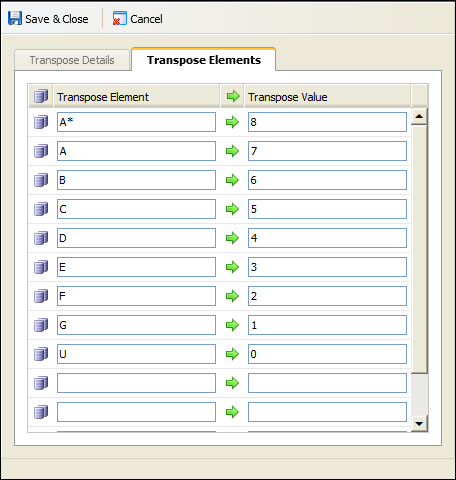
5. Use the fields available to add Transpose Elements to your Transpose Object. Complete the fields in order of merit with the highest value Transpose Element at the top of the list.
a) Enter the grade that you want to transpose in the Transpose Element field.
b) Then enter a Transpose Value for the grade. For example, for the grade 'A*' enter a Transpose Value of '8'.
6. Click  Save & Close once you have completed the Transpose Elements fields.
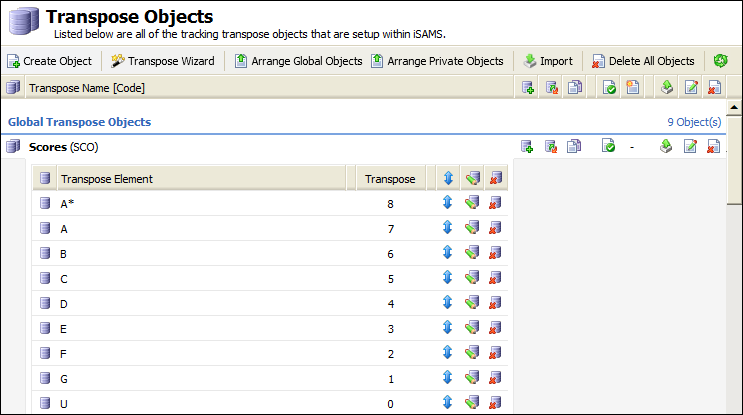
Your Transpose Object, and its associated Transpose Elements, is added to the list of Transpose Objects in the Transpose Objects screen. Global Transpose Objects and Private Transpose Objects are listed separately, all newly created Transpose Objects are at the end of the lists displayed.
An example of how Transpose Objects are displayed in the Transpose Object option is shown below:
Copy an Existing Transpose Object
Copy an existing Transpose Object to save time when you have different types of data that you want to transpose in the same way. After you have copied the Transpose Object you can choose to edit the Transpose Details and Transpose Elements.
To copy an existing Transpose Object, follow the steps below:
1. In the Configuration tab, select Transpose Objects from the right hand menu.
The Transpose Objects screen is displayed. An example is shown below:

2. Click  in the Transpose Object you want to copy.
You are prompted Are you sure you want to copy this transpose object?
3. Click Yes.
A copy of the Transpose Object and all the associated Transpose Elements is listed in the Transpose Objects screen. Copied Transpose Objects are easily identified by name, for example 'Copy of Number' is listed when 'Number' is copied.
You are now ready to edit the copied Transpose Object and the Transpose Elements associated with it. See Edit a Transpose Object and Edit a Transpose Element for more information.
Reverse an Existing Transpose Object
Choose to reverse the values used in a Transpose Object as a shortcut to editing your Transpose Object. This saves time as you do not have to edit each Transpose Element individually. Reversing a Transpose Object reverses the order of the numerical values associated with each Transpose Element.
For example, where previously an effort grade of '1' would be the highest grade awarded and have a numerical value of 5. Now effort grade '5' is the highest grade with a value of 5 and effort grade '1' is the lowest grade with a value of 1.
To reverse a Transpose Object, follow the steps below:
1. In the Configuration tab, select Transpose Objects from the right hand menu.
The Transpose Objects screen is displayed. An example is shown below:

2. Click  in the Transpose Object you want to reverse.
You are prompted Are you sure you want to reverse this transpose object?
3. Select Yes.
Your selected Transpose Object is copied and listed in reverse order in the Transpose Objects screen. Reversed Transpose Objects are easily identified by name, for example 'Reverse of Effort' is listed when 'Effort' is reversed. The original Transpose Object is still listed. An example of your reversed Transpose Object is shown below:

Edit a Transpose Object
Choose to edit a Transpose Object if you want to change any of its properties. For example, change its active status. It is not recommended that you edit a Transpose Object once it is in use as this can alter your Tracking Models. Choose to Copy an existing Transpose Object then edit the copy if the Transpose Object is already in use.
To edit a Transpose Object, follow the steps below:
1. In the Configuration tab, select Transpose Objects from the right hand menu.
The Transpose Objects screen is displayed.
2. Click  in the Transpose Object you want to edit.
See below for the location of the edit icon:

The Edit Transpose Object window is displayed. An example is shown below:
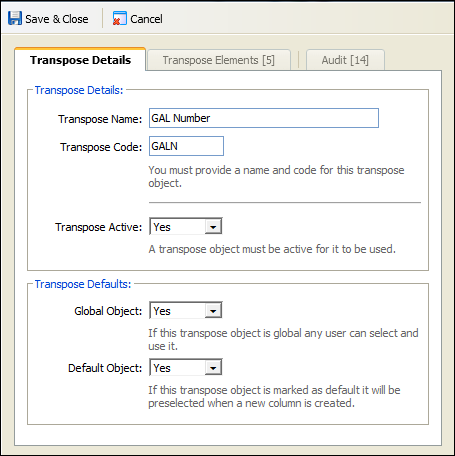
3. Edit the sections available in the Transpose Details tab, as required:
Section | Explanation |
Transpose Details | Transpose Name. Use a clear, concise and unique name for your Transpose Object. This refers to the data you want to change in the module, for example 'Scores'. This is displayed when creating columns in Tracking Models. |
Transpose Defaults | Global Object. Select Yes for all Tracking Manager Module users to use this Transpose Object. Select No for the Transpose Object to be listed as Private (only you can use a Transpose Object listed as Private). Default Object. Selecting Yes preselects this Transpose Object when you choose to use Transpose Objects to make column adjustments in your Tracking Models. Default Transpose Objects are identified by the |
4. Select the Transpose Elements tab to edit the Transpose Elements in your Transpose Object.
An example of the Transpose Elements tab is shown below:
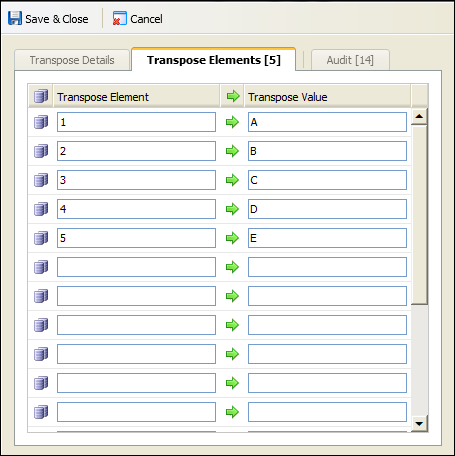
5. Use the fields available to add Transpose Elements to your Transpose Object. Complete the fields in order of merit with the highest value Transpose Element at the top of the list.
a) Enter the grade that you want to transpose in the Transpose Element field.
b) Then enter a Transpose Value for the grade. For example, for the grade 'A*' enter a Transpose Value of '8'.
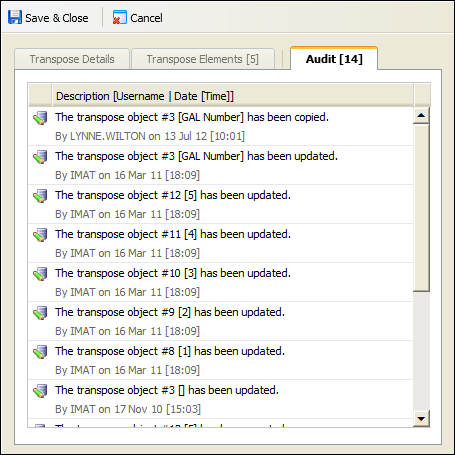
6. Select the Audit tab to view an audit log for the Transpose Object. This is useful for viewing a history of changes made to the Transpose Object.
An example of the Audit tab is shown below:
7. Click Save & Close. The changes you make are displayed in the Transpose Objects screen.
Delete a Transpose Object
Choose delete a Transpose Object which you no longer require. You can also choose to delete all of the Transpose Objects in the Tracking Manager Module, if required. Be careful when deleting any Transpose Objects which are already in use. Deleting Transpose Objects alters the Tracking Models they are used in.
To delete a Transpose Object, follow the steps below:
1. In the Configuration tab, select Transpose Objects from the right hand menu.
The Transpose Objects screen is displayed.
See below for the location of the delete buttons:
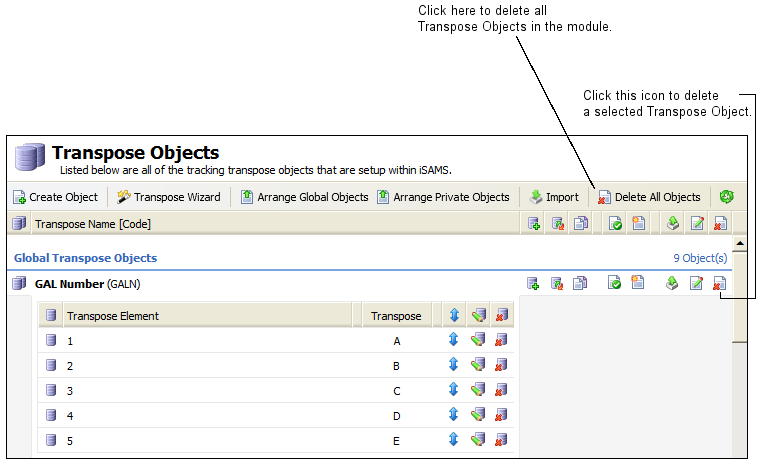
2. Either:
a) Click  in the Transpose Object you want to delete. You are prompted Are you sure you want to delete this transpose object?
b) Select Yes. Your selected Transpose Object is removed from the module.
or
a) Click  . You are prompted Are you sure you want to delete all the transpose objects?
b) Select Yes. All Transpose Objects are removed from the module.
Export a Transpose Object
Export your Transpose Objects to save a backup of the Transpose Objects that you use. This is useful if you have to re-install the module at any point as your Transpose Objects will not be saved. Also choose to export Transpose Objects if you want to share the Transpose Objects that you use with other schools.
To export a Transpose Object, follow the steps below:
1. In the Configuration tab, select Transpose Objects from the right hand menu.
The Transpose Objects screen is displayed.
2. Click  in your selected Transpose Object.
See below for the location of the edit icon:
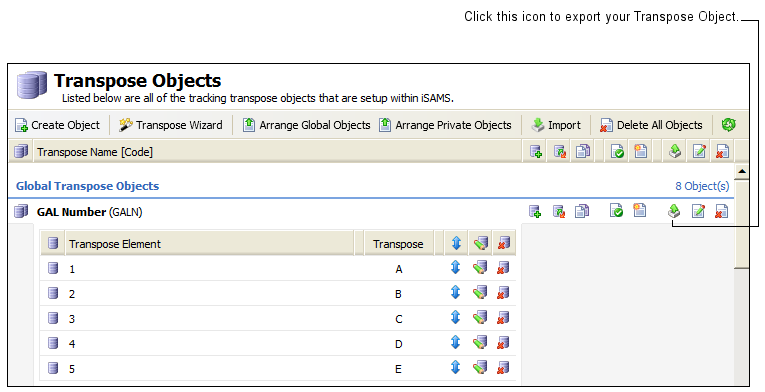
You are prompted Do you want to open or save transpose.xml...?
3. Open or Save the file as you require. The Transpose Object is exported as an XML document.
If you have selected to save the file, you are prompted when the download is complete.
Import a Transpose Object
Import Transpose Objects from an external source into iSAMS. This is useful when you have had to re-install the module and want to re-install the Transpose Objects that you have previously exported. This also gives you the option of using Transpose Objects recommended by iSAMS or by another school.
To import a Transpose Object, follow the steps below:
1. In the Configuration tab, select Transpose Objects from the right hand menu.
The Transpose Objects screen is displayed.
2. Click  at the top of the screen.
The Upload Transpose Object window is displayed. An example is shown below:

3. Click Browse and select the file you want to import. The file you select must be an XML document.
4. Click  .
.
You are prompted when the import is complete.
5. Click OK.
Your imported Transpose Object is listed in the Transpose Objects screen.
Arrange Transpose Objects
Change the order that Transpose Objects are displayed in the module. Global and Private Styles are listed and arranged separately. Choose to the list the most used Transpose Objects at the top of the list, this saves time when you are selecting a Transpose Object for your Tracking Model.
To arrange Transpose Objects, follow the steps below:
1. In the Configuration tab, select the Transpose Objects option from the right hand menu.
The Transpose Objects screen is displayed.
2. Either:
Click  .
.
or
Click  .
.
The Arrange Transpose Objects window is displayed. An example is shown below:
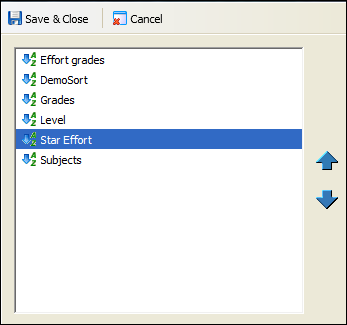
3. Select a Transpose Object and use the arrows available to move it up or down the list:


4. Click Save & Close.
The Transpose Objects are now displayed throughout the Tracking Manager Module in the revised order.
Add a Transpose Element
To add a Transpose Element to a Transpose Object, follow the steps below:
1. In the Configuration tab, select Transpose Objects from the right hand menu.
The Transpose Objects screen is displayed.
2. Click  in your select Transpose Object.
See below for the location of this icon in the Transpose Objects screen:
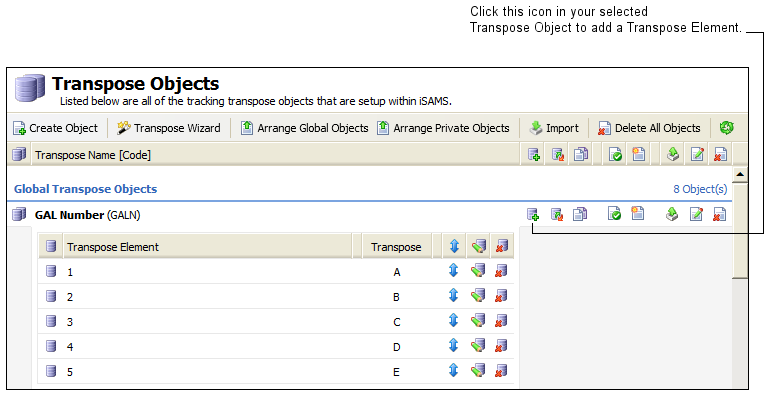
The Create Transpose Element window is displayed. An example is shown below:

3. Use the fields available to enter details of the Transpose Element you want to add:
Field | Explanation |
Element Value | Enter the term/grade that you want to transpose. |
Transpose Value | Enter a value for the term/grade. For example, for the grade '6' enter a value of 'F'. When you choose to apply this Transpose Object in your Tracking Models all grades of '6' are displayed as an 'F'. |
4. Click Save & Close.
The new Transpose Element is added to the list of Transpose Elements associated with the Transpose Objects. An example is shown below:
5. Either:
Add more Transpose Elements, as required.
or
Change the order of the Transpose Elements to reflect the correct order of merit. See Arrange Transpose Elements for more information.
Edit a Transpose Element
Choose to edit a Transpose Element if the term used in the data you are transposing has changed. It is not recommended that you edit a Transpose Element once it is in use as this can alter your Tracking Models.
To edit a Transpose Element, follow the steps below:
1. In the Configuration tab, select the Transpose Objects option from the right hand menu.
The Transpose Objects screen is displayed.
2. Click  in your selected Transpose Element.
See below for the location of this icon in the Transpose Objects screen:

The Edit Transpose Element window is displayed:

3. Use the fields available to edit the details of the Transpose Element:
Field | Explanation |
Element Value | Enter the term/grade that you want to transpose. |
Transpose Value | Enter a value for the term/grade. For example, for the grade '6' enter a value of 'U'. When you choose to apply this Transpose Object in your Tracking Models all grades of '6' are displayed as an 'U'. |
4. Click Save & Close.
The changes you make are displayed in the Transpose Objects screen.
Delete a Transpose Element
Choose to delete a Transpose Element which you no longer require. Be careful when deleting any Transpose Elements which are already in use. Deleting Transpose Elements alters the Tracking Models they are used in.
To delete a Transpose Element, follow the steps below:
1. In the Configuration tab, select the Transpose Objects option from the right hand menu.
The Transpose Objects screen is displayed.
2. Click  in your selected Transpose Element.
See below for the location of this icon in the Transpose Objects screen:

You are prompted Are you sure you want to delete this transpose element?
3. Select Yes.
The Transpose Element is removed from the module.
Arrange Transpose Elements
Change the order that Transpose Elements are displayed in the module. This is quick way to change Transpose Elements into the correct order of merit.
To arrange Transpose Elements, follow the steps below:
1. In the Configuration tab, select the Transpose Objects option from the right hand menu.
The Transpose Objects screen is displayed.
2. Click  next to any Transpose Element in your selected Transpose Object.
See below for the location of this icon in the Transpose Objects screen:

The Arrange Transpose Elements window is displayed. An example is shown below:

3. Select a Transpose Element and use the arrows available to move it up or down the list:
List the Transpose Elements in order of merit with the highest value Transpose Element at the top of the list.
4. Continue to move Transpose Elements up and down the list until you are satisfied with the order.
5. Click Save & Close.
The Transpose Elements are now displayed throughout the Tracking Manager Module in the revised order.